
Every patient who sits down for a consultation about ageing skin is, in effect, asking the same question: can the clock be persuaded to run backwards? For most of the history of aesthetic medicine, the answer has been mechanical; lift, fill, resurface, tighten.
What has changed in recent years is the emergence of treatments that work less like tools and more like messages to the skin’s own cells, asking them to repair and renew themselves.
At the centre of this shift sits the exosome, and exosome-based therapies are now widely discussed as the new frontier in anti-ageing treatments, a frontier still being mapped, but worth a practitioner’s attention.
What Is an Exosome? The Biology Behind a Signalling Therapy
Exosomes are nanoscale extracellular vesicles, tiny membrane-bound packages typically 30 to 150 nanometres across, released by almost all cells as part of normal intercellular communication. Each vesicle carries a cargo of proteins, lipids and microRNA, and on reaching a neighbouring cell it can influence that cell’s behaviour: switching on repair pathways, modulating inflammation, or encouraging the production of structural proteins such as collagen and elastin.
In aesthetic practice, the exosomes of greatest interest are those derived from mesenchymal stem cells, often sourced from adipose tissue, bone marrow or umbilical cord tissue. The appeal lies in the logic of paracrine signalling: rather than transplanting cells themselves, the therapy delivers the signals those cells would normally send.
This is the conceptual foundation of regenerative aesthetics, the idea that the skin’s own repair machinery, properly instructed, can do much of the work that fillers and resurfacing devices do mechanically.
How Exosome Treatment Works: Mechanism and Delivery
An exosome treatment, in its most common clinical form, involves applying a concentrated preparation of vesicles to the skin, typically alongside a delivery method that improves penetration past the stratum corneum. Microneedling and ablative or fractional laser resurfacing are the two most commonly used, both creating temporary microchannels for vesicles to reach the dermis.
Once delivered, the proposed mechanism is that exosomes are taken up by resident fibroblasts and keratinocytes, where their cargo may help upregulate collagen synthesis, support angiogenesis and reduce post-procedure inflammation.
In practice, this means exosome treatment is rarely offered as a stand-alone intervention. At present, it functions as an adjunct intended to support recovery from, and enhance the results of, an established procedure.
Exosome Facial Therapy: Applications in Skin Rejuvenation
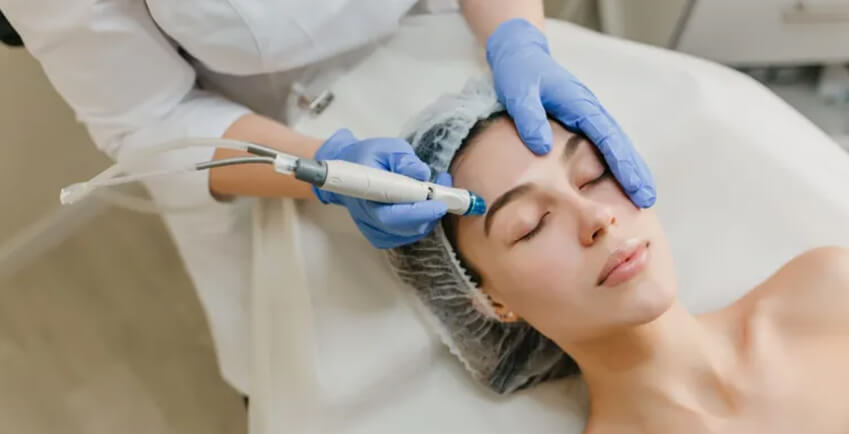
The most visible application of this science is exosome facial therapy, typically performed alongside microneedling or laser treatment for skin rejuvenation. Patients presenting with photoageing, fine lines, textural irregularity or dullness are most often considered, particularly those already booked for a resurfacing procedure.
One randomised, split-face study illustrates the direction of this research: it compares a 1064 nm Nd:YAG laser used alone against the same laser combined with topical exosomes derived from umbilical cord mesenchymal stem cells, with skin rejuvenation as the primary outcome. Studies of this design, an established device, with and without an exosome adjunct, are likely to be the template through which exosome facial therapy is validated, or not, in the coming years.
What the Evidence Shows: Exosome for Skin Rejuvenation in the Literature
Here, candour matters more than enthusiasm. A 2024 systematic review of topical exosome and peptide therapies, following PRISMA guidelines, found early trial data promising but concluded that neither was approved for skin rejuvenation, with data published since 2010 remaining sparse.
A 2026 dermatology review similarly noted that exosome-based therapies show potential in skin rejuvenation, wound healing, scar modulation and hair restoration, while cautioning that variability in cell sourcing and manufacturing makes standardisation difficult.
The comparison with platelet-rich plasma is instructive. PRP is supported by multiple randomised controlled trials for both skin rejuvenation and hair restoration. The literature on exosome for skin rejuvenation, by contrast, consists primarily of preclinical work and small case series. That gap may narrow as larger trials report, but it should not be minimised in the meantime, particularly when counselling patients.
Regenerative Medicine in Aesthetics: Where Exosomes Sit Alongside PRP
Exosome therapy is best understood as one entrant in a broader category, regenerative medicine in aesthetics, that already includes PRP, adipose-derived stem cells and stromal vascular fraction. What distinguishes exosomes from PRP is sourcing: PRP is autologous, drawn from the patient’s own blood, while most exosome preparations are allogeneic, derived from donor cell cultures.
That distinction matters clinically. Autologous products carry a lower theoretical risk of immune reaction and a more permissive regulatory path in many jurisdictions. Allogeneic, cell-culture-derived exosome products sit much closer to the regulatory treatment of biological medicines, a point developed below.
Patient Selection and Candidacy
Several considerations should inform whether exosome treatment is appropriate for a given patient:
- Patients seeking adjunctive support for an established procedure, such as microneedling or laser resurfacing for early photoageing, are the most defensible current candidates for exosome facial therapy, given appropriate counselling.
- Patients seeking exosome treatment as a stand-alone anti-ageing treatment, expecting transformative or guaranteed results, are not well served by the current evidence base and should be counselled accordingly.
- Patients with active dermatological infection, known hypersensitivity to biological or donor-derived products, or pregnancy or breastfeeding are generally better excluded pending further safety data.
- Patients should understand exosome-based protocols sit within a broader regenerative aesthetics plan, not as a substitute for one.
Safety, Regulation and Honest Expectations
At present, exosome-derived products do not have widely accepted regulatory approval for aesthetic skin-rejuvenation indications in major regulatory frameworks, and their clinical use remains unsettled.
Under the Indian Council of Medical Research’s 2017 National Guidelines for Stem Cell Research, interventions involving stem cells and their derivatives, which extend to extracellular vesicle and exosome applications, are expected to occur within sanctioned clinical trials, overseen by a registered Institutional Committee for Stem Cell Research and Institutional Ethics Committee.
In effect, such products are treated as biological medicinal products under the Drugs and Cosmetics Act, subject to Central Drugs Standard Control Organisation oversight.
For practitioners, several points follow:
- Sourcing, characterisation and manufacturing quality vary considerably between products, and sector-wide standardisation remains incomplete.
- Adverse reactions have been documented in the literature, alongside limited long-term follow-up, and these should form part of informed consent.
- Patients should be told plainly that exosome-based anti-ageing treatments remain investigational in India and most jurisdictions, rather than approved indications, regardless of marketing claims.
Conclusion: A Frontier Worth Watching, Not Yet Worth Overselling
Exosome-based therapies occupy an unusual position within aesthetic medicine: biologically coherent, clinically promising in early studies, and administratively unsettled. The signalling logic that underpins exosome treatment, recruiting the skin’s own repair pathways rather than mechanically altering structure, represents a genuine departure from much of what regenerative aesthetics has offered before, and deserves serious attention from anyone practising in this space.
But seriousness cuts both ways: tracking the literature as it matures, understanding where exosome for skin rejuvenation sits relative to better-established options such as PRP, and being candid with patients about what remains unproven and unapproved. The practitioners who serve this frontier well will not be those who arrive first, but those who arrive prepared.
The frontier is real. What it asks of us, for now, is patience rather than promises.
Author: Dr. Shilpi Bhadani
Disclaimer : The opinions here are personal views of the authors. IAAPS is not responsible. All members may not have the same scientific view point