
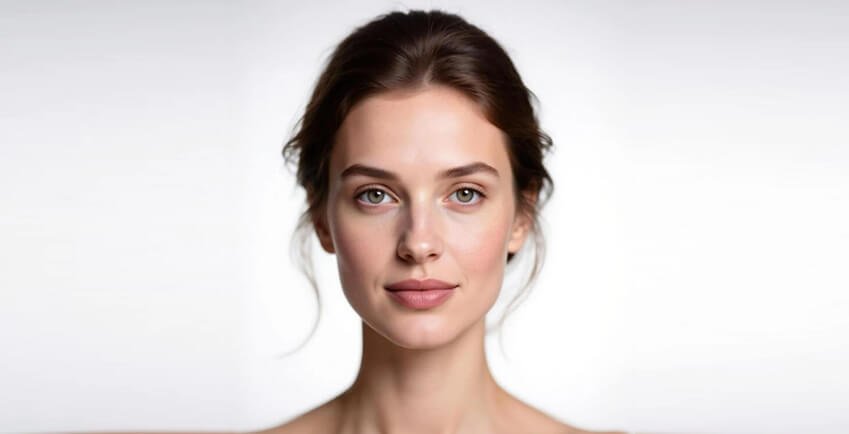
Last month, a young techie walked into our busy OPD, for a consultation. He waited and waited till we cleared out the rush and sat with him. He explained to us he was unhappy with his broad nose and wide ala. He created his ideal nose on an AI website and showed it to us. “Is this possible? Or should I go somewhere else where?”
It felt more like an ultimatum than a consultation. As per the aesthetic principles, he was a typical “SIMON”.
The over-expentact patient baffled us and gave us a tough time. The never ending repetitive questions which did not lead to changes in treatment protocol, exhausted us and ate away at other patients’ time.
This made us realise that this is a glimpse into the future. A world full of SIMON’s rather than SYLVIA’s as AI tools become an inseparable part of our out-patient clinics. That consultation stayed with me, for it captured the question our specialty can no longer dodge. Can artificial intelligence design your new face?
Addressing the elephant in the room, what is this “intelligence” anyway? Strip away the hype and artificial intelligence is pattern recognition at an inhuman scale. Machine learning algorithms study thousands of faces, outcomes and photographs, and learn what usually follows what. Computer vision teaches software to “see”, to find the nasion, the tip-defining points, the orientation of cartilages, the jowl and other inconsistencies, faster than a tired resident at 3am ever could. That, in essence, is AI in Plastic Surgery. Not a robot with a scalpel, but a very diligent apprentice who has read every textbook and remembers every case, yet has never once touched a patient.
From tracing paper to digital twins:
Previous generations of plastic surgeons planned faces with callipers, cephalograms, clinical judgements and experience. Then came 2D morphing software, which let us stretch a profile photograph the way one stretches the truth, pretty convincingly, but only from one angle. Today, artificial intelligence in aesthetic medicine has leapt far beyond that. Platforms can convert a few smartphone photographs into a three-dimensional “digital twin” of the patient, on which we can rehearse the operation before a single incision is made. A 2025 systematic review spanning fifteen years of literature found validated AI models being applied across nearly every corner of our specialty, from diagnosis to outcome prediction. The apprentice has been busy.
What an AI actually does in the clinic today?
AI facial analysis now performs in seconds what once consumed half a consultation and every ounce of imagination and measurements. Automated landmark detection, symmetry mapping, skin-quality grading and facial harmony analysis measured against classical canons. AI face simulation takes it further with 3D platforms such as Crisalix, Rhinocceros, Vectra and others used across many countries, allow patients to preview a rhinoplasty or facelift on their own face Recent studies show that when the simulation closely matches the final result, postoperative satisfaction rises. That is no small thing in a specialty where dissatisfaction so often stems not from bad surgery but from mismatched imaginations and expectations of the patient.
AI rhinoplasty planning helps us model tip rotation and dorsal reduction on the patient’s own anatomy rather than on a borrowed celebrity photograph. AI facelift planning quantifies volume loss and tissue descent, suggesting where a millimetre of lift matters most. AI hair transplant planning has gone furthest of all. The FDA-cleared ARTAS robotic system uses stereoscopic vision to map the donor area, score each follicular unit and harvest grafts tirelessly, hour after hour, without the tremor of a fatigued hand.
Beyond the operating theatre, predictive analytics are learning to flag patients at higher risk of complications, standardise clinical photography, generate objective outcome scores, and even draft patient counselling material. Personalised aesthetic planning, the dream of tailoring every operation to one face, one anatomy, one expectation is closer than it has ever been. Integrated with augmented reality and robotics, aesthetic surgeons rehearsing surgeries on AI-models might become the norm rather than the exception.
Now for the cold coffee….
And yet. Every technology arrives with fine print, and AI’s fine print deserves a magnifying glass. Bias is the first worry. Algorithms learn from the data they are fed, and most were fed predominantly Caucasian faces. An AI beauty analysis trained on one population may quietly declare another population’s features “flawed” or “not beautiful”. Even ARTAS, marvellous as it is, is FDA-cleared only for straight black or brown hair, the camera simply cannot see what it was never taught to see. For a country as gloriously diverse as ours, that is not a footnote, it is a warning.
Unrealistic expectations come next. A simulation is a promise rendered in pixels, and tissue is not pixels. Skin thickness, scarring, healing biology reserves the right to improvise. If the app promises a nose the flesh cannot deliver, who explains the gap? Then comes data privacy and consent. A facial scan is not just a photograph, it is biometric data, and it deserves the same reverence as a blood sample. And medicolegally, if an algorithm’s simulation oversells and a patient sues, the courtroom will not summon the software. It will summon the surgeon.
Which brings me to the question in the title. Can AI design your new face? It can propose one. It can measure, simulate, predict and dazzle. But it cannot palpate skin elasticity, notice the tremor in a patient’s voice when she mentions her wedding, or recognise body dysmorphic disorder hiding behind a perfectly reasonable request. It has never held a retractor at midnight or the hand of an anxious mother at dawn. Surgery is an amalgamation of numerous tiny decisions and judgement which for now, and I suspect for long after, remains stubbornly human.
Take home message:
Use AI plastic surgery planning the way I use my morning newspaper. As an indispensable ritual that informs the day, never as a substitute for living it. Let the algorithm measure, but you decide. Let it simulate but you consent, counsel and operate. The surgeons who thrive in the coming decade will not be those who resist AI, nor those who surrender to it, but those who supervise it and work with it. The machine can sketch a face. But only a surgeon can be answerable to it.
Author: Dr. Risha Shetty
Disclaimer : The opinions here are personal views of the authors. IAAPS is not responsible. All members may not have the same scientific view point