
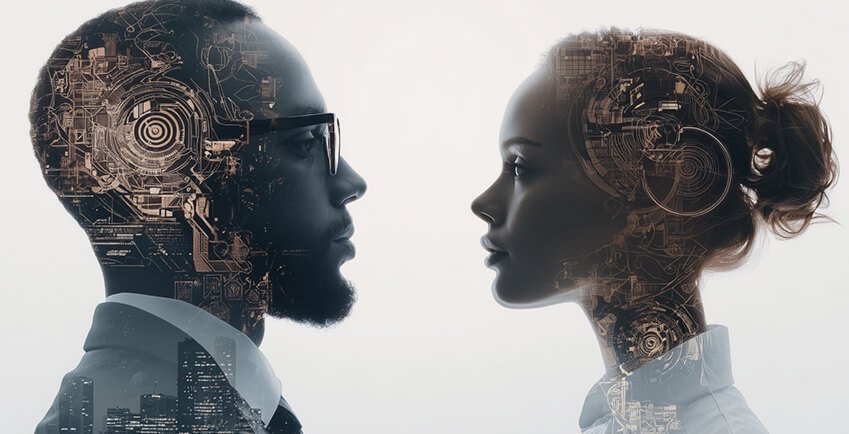
Imagine sitting in front of a screen while a camera studies your face. Within seconds, it maps your proportions, measures asymmetry, and generates several versions of how you might look after surgery. A sharper jawline, straighter nose, lifted brows, or a restored hairline appears with a click. This experience feels futuristic, precise, and deeply personal.
But can Artificial Intelligence truly design your new face?
The honest answer is: it can help design a plan, but it must never be allowed to define your beauty or replace the surgeon who understands the person behind the photograph.
Today, Artificial Intelligence has entered the consultation room. With the help of facial scanning, AI can analyse a face and create possible postoperative appearances within seconds.
But, a face is more than a set of measurements and not merely a collection of individual parts. A beautiful nose may not look beautiful on every face. A strong chin may improve one profile but appear excessive in another. Similarly, perfect symmetry does not always create attractiveness. The essence of facial aesthetics lies in balance.
Modern software can identify facial landmarks, compare both sides of the face, and measure the relationship between different facial landmarks. It can assist in Facial harmony analysis by showing how one feature influences the appearance of another. For example, a patient may believe his nose is too prominent. On assessment, the nose may be only mildly prominent, while the chin is relatively small. In such a case, altering the chin may improve the entire profile more naturally than performing a rhinoplasty.
However, facial proportions alone do not tell the complete story. A surgeon also notices skin quality, ethnicity, age, and the way the face moves while speaking or smiling.
The role of AI in Plastic Surgery is best understood as that of an assistant. It can collect information, analyse patterns, and help the surgeon explain the treatment plan. This is especially helpful because patients often use broad words such as ‘natural,’ ‘sharp,’ ‘young,’ or ‘balanced,’ which can mean very different things to different people. A digital image helps the patient point out what they like and dislike. It allows the surgeon to explain why a certain change may or may not be suitable.
Used wisely, Artificial Intelligence in Aesthetic Medicine can convert a vague request—“I want to look better”—into a clearer conversation: What is bothering the patient? Which change would improve balance, and what should remain untouched?
It can improve communication between patient and surgeon. But, a patient should never feel pressured to undergo a procedure simply because software has highlighted an asymmetry. The purpose of technology should be to support informed decision-making, not to create new insecurities.
AI Face Simulation is another attractive feature of artificial intelligence, allowing a patient to see a digitally altered version of their face before surgery. The nasal bridge can be reduced, the jawline sharpened, or the hairline restored.
In AI rhinoplasty planning, the surgeon may demonstrate how changing the bridge, tip, or projection of the nose can affect the profile.
In AI facelift planning, digital tools may help identify areas of volume loss, skin laxity, and changes around the eyes, cheeks, jawline, and neck.
In AI hair transplant planning, software may assist in designing the hairline, estimating the area requiring coverage, and planning the distribution of grafts.
However, surgery takes place in living tissue, not on a photograph, and the image on the screen must never be presented as a guaranteed result. Skin thickness, cartilage strength, movement, wound healing, scar formation, and individual anatomy all influence the final outcome. A computer-generated image is created in a world without swelling, bleeding, fibrosis, or biological variation. Ethical practice requires every simulation to carry an important label: possible outcome, not promised outcome.
Can AI Decide What Is Beautiful?
Many people are already exposed to artificial versions of beauty through social media filters. These filters often create the same type of face: a narrow nose, larger eyes, smooth skin, and a sharp jawline. When people repeatedly see this edited appearance, they may begin to consider normal facial features unattractive.
AI Beauty Analysis can create a similar problem if it attempts to assign a score to a face or compare every patient with a fixed standard. But, beauty does not have a universal definition. It varies with culture, ethnicity, age, gender, and personal preference. Indian faces alone show immense diversity. A feature that appears harmonious in one person may not suit another.
A responsible plastic surgeon does not try to create the same nose, lips, or jawline for every patient. That is why personalised aesthetic planning is so important. The treatment plan should begin with the patient’s own face, concerns, and expectations. AI may provide measurements and options, but the final plan must respect identity. The best aesthetic result is not the one that looks most different. It is the one that looks natural enough for people to say, “You look better,” without being able to identify exactly what has changed.
Planning Requires Judgement, Not Just Software
Artificial intelligence can help organise photographs, compare preoperative and postoperative images, document asymmetry, and assist in planning. But surgery requires judgement. A computer may identify a facial imbalance, but it cannot decide whether correcting it is necessary. It may generate an idealised image, but it cannot assess whether the patient’s expectations are realistic.
A plastic surgeon must understand why the patient wants the procedure. Is the patient seeking improvement, or perfection? Is the patient emotionally prepared for surgery and recovery? Would a smaller procedure be more appropriate? Would it be safer not to operate? Sometimes the answer is to advise no surgery at all. No algorithm can carry that responsibility.
The Importance of Trust and Privacy
Facial photographs and three-dimensional scans are highly personal. If AI-based platforms are used, patients should know where their images are stored, who can access them, and whether they may be used for software training. Patients should also know that not every digital platform has been tested equally across different skin types, ethnicities, and facial features. Technology should not compromise privacy or trust.
So, Can AI Design Your New Face?
AI Facial Analysis may improve communication and assist in planning facial procedures. It can help visualise possibilities. But, it cannot feel tissue, assess healing biology, or make complex decisions during surgery. It cannot replace experience, artistic judgement, empathy, or responsibility.
A face is not a digital project. It belongs to a living person. The experience of the plastic surgeon remains irreplaceable. The ability to understand anatomy, assess
tissue quality, anticipate healing, recognise limitations, and modify the plan during surgery can only develop through years of training and clinical judgement. Therefore, AI should not be seen as the designer of a new face. It should be seen as a ‘modern instrument in the hands of a plastic surgeon.’
Artificial Intelligence may help draw the plan, but the surgeon must decide whether that plan is safe, realistic, and appropriate. The patient must always remain at the centre of that decision.
Author: Dr. Shubham Ahuja
MCh Senior Resident
Burns, Plastic and Maxillofacial Surgery
VMMC and Safdarjung Hospital
+91-9999-883-559
drshubhamahuja@gmail.com
Disclaimer : The opinions here are personal views of the authors. IAAPS is not responsible. All members may not have the same scientific view point