
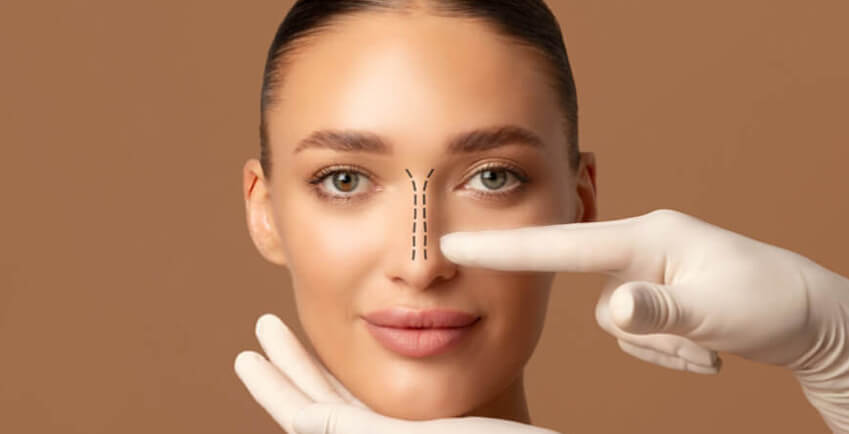
Rhinoplasty is one of the most popular cosmetic procedures, yet also one of the most misunderstood. With terms like liquid rhinoplasty, ultrasonic rhinoplasty, open, closed and preservation techniques, patients often feel confused and unsure about what they truly need.
What Rhinoplasty can do:
Rhinoplasty reshapes the nose to improve facial appearance and/or nasal breathing.
Cosmetically, it can refine the size, bridge, tip, nostrils, or straighten a crooked nose for better facial harmony. Functionally, it corrects structural problems such as a deviated septum or trauma to restore normal breathing.
A Patient’s Guide to Choosing the Right procedure and Surgeon
Being a rhinoplasty surgeon, my purpose of writing this blog is to give clarity to the thoughts of rhinoplasty seekers, so they should take right decision. It should help them understand their deformity, explain their options in simple terms, and guide them toward the most suitable procedure so they can make an informed and confident decision.
The goal of this guide is simple:
To help rhinoplasty seekers understand what they need, what they can expect, and which procedure best fits their deformity, profession, and available recovery time.
Clear thoughts lead to clear choices.
Before choosing any rhinoplasty procedure, it’s important for every patient to have absolute clarity about their own concerns. A good starting point is to ask yourself a few basic questions:
- What exactly bothers me about my nose? Is it the hump? Tip drooping? Wide nostrils? Crooked shape? Breathing difficulty?
- Why do I want to change it? Cosmetic improvement, better breathing, more confidence, or camera-friendly angles for professional needs?
- What outcome am I hoping for, functional improvement, aesthetic refinement, or both?
- Can I afford to have long downtime (recovery period )?
A rhinoplasty surgeon’s job is to clarify your concerns, give you a realistic plan, and help you choose the safest and most effective treatment.
Patients who have subtle deformities like minor asymmetry, small irregularities, minor hump or want little elevation of dorsum or projection of tip, and cannot afford a long recovery period, are ideal candidates for nonsurgical rhinoplasty.
Nonsurgical Rhinoplasty (Liquid Rhinoplasty): It is performed using hyaluronic acid fillers to reshape the nose without surgery. It offers:
- Instant results
- Almost no downtime
- A trial of the desired shape: you get to see if the changes match your expectations
- Flexibility: Results are temporary but adjustable, you can choose a slightly different shape next time, which is especially useful for people in acting or modelling professions, influencers, public-facing professionals with tight schedules and brides/grooms needing quick enhancement, where appearance may need flexible adjustments
- Reversibility: Most importantly, if the filler used is hyaluronic acid, any unsatisfactory result or complication can be reversed safely with an enzyme called hyaluronidase.
However, remember that this approach is suitable only for minor contour refinements and not for major structural problems.
When should you NOT choose nonsurgical rhinoplasty. Avoid it if you have:
- Large dorsal humps
- Saddle nose (loss of septal support)
- Severe crookedness or deviation
- Significant functional problems
- Thick skin requiring structural tip work
- Post-traumatic deformities
- Congenital conditions (e.g., cleft lip nose, Binder syndrome, congenital short nose)
These cases require structured surgical rhinoplasty, not fillers.
Surgical Rhinoplasty: All above mentioned deformities of nose need surgical rhinoplasty for structural, cosmetic and functional improvements.
These can be effectively managed by Closed/Open rhinoplasty or Preservation rhinoplasty, depending on the case.
Understanding Surgical Approaches:
Patients often get confused between Closed, Open and Preservation rhinoplasty. These are not different surgeries, but different approaches your surgeon may choose based on the complexity of your nose.
- Closed Rhinoplasty
All cuts are placed inside the nose, with no visible scar on the outside.
- Advantages: shorter operating time, quicker recovery, less swelling.
- Best for: primary rhinoplasty cases where the deformity is mild to moderate and the tip does not need extensive restructuring.
- Open (External) Rhinoplasty
- The only difference from the closed approach is a small transverse or inverted-V incision on the columella (the skin between the nostrils).
- Advantages: excellent exposure, precise tip work, ideal for complex shaping.
- Typical use: difficult primary cases, revision rhinoplasty or noses operated multiple times.
- Considerations: longer surgery, more swelling, often more cartilage grafting is required, and recovery is slightly slower.
- Preservation Rhinoplasty
This technique aims to preserve the natural dorsum, bones, cartilage and soft-tissue ligaments. So the nasal dorsum and tip support can be maintained rather than rebuilt.
- Usually performed through a closed approach, making it minimally invasive.
- In complex cases, a hybrid method may be used. Open exposure combined with partial preservation of the dorsum and selected ligaments is done.
- Best for patients with humped nose and deviated nose(not crooked nose), with or without hump.
Ethnic Rhinoplasty
You may hear the term “ethnic rhinoplasty.” It simply means reshaping the nose in a way that enhances appearance while preserving a person’s natural ethnic features, respecting those unique traits instead of trying to create a one-size-fits-all nose. Different communities have characteristic nasal shapes, for example, many North Indians tend to have slightly longer noses, South Indians often have shorter noses with thicker skin, North-Eastern individuals may have a lower and flatter nasal bridge, and similar variations are seen among Caucasian, Hispanic, Middle Eastern, and African populations.
Understanding “Ultrasonic Rhinoplasty”
Don’t be misled by terms like Ultrasonic Rhinoplasty or Piezo Rhinoplasty. They may sound like special new surgeries, but they are not separate procedures. They simply refer to the use of an ultrasonic (piezoelectric) device during a standard rhinoplasty to work on the nasal bones.
This device:
• Cuts and smoothens the bones with high precision
• Is gentler on surrounding soft tissues and cartilage
• Often results in less bruising and swelling
• Does not change any other step of the surgery
It’s not a different technique, just a modern tool used for bone shaping. The real key to good results is the surgeon’s skill, judgment and choosing the right approach and not the device.
What Rhinoplasty can’t do:
While rhinoplasty can greatly enhance appearance and function, it has limitations: It’s important to set realistic expectations:
- Perfect symmetry is not achievable all the time.
- An extremely sharp or overly refined tip is difficult in patients with thick sebaceous skin.
- Secondary or multiple revision cases may require complex reconstruction, often not possible with closed approaches.
- You cannot get a nose identical to your favourite celebrity. Your anatomy and facial proportions are unique.
- Nonsurgical rhinoplasty is not suitable for severe deformities or cases requiring structural support.
When selecting your surgeon, consider their credentials like board certification in the relevant specialty or fellowship, and active membership in professional societies. Equally important are their experience and outcomes, so ask how often they’ve performed this procedure, review before‑and‑after photos or published results, and inquire about complication and revision rates. Finally, evaluate communication and trust, the right surgeon listens carefully, explains clearly without jargon, welcomes questions and is transparent about risks, alternatives and recovery, respects your natural identity and preserves the ethnic characteristics to deliver natural-looking results and not a “one-nose-fits-all” outcome.
“And remember, rhinoplasty is a complex surgery, and even in the best hands, the final result can sometimes require a small touch-up or, in rare cases, a full revision.”
Clear information leads to clear decisions.
Written by: Dr Kapil S Agrawal, Professor of Plastic Surgery, GSMC and KEM Hospital, Mumbai
Disclaimer : The opinions here are personal views of the authors. IAAPS is not responsible. All members may not have the same scientific view point