
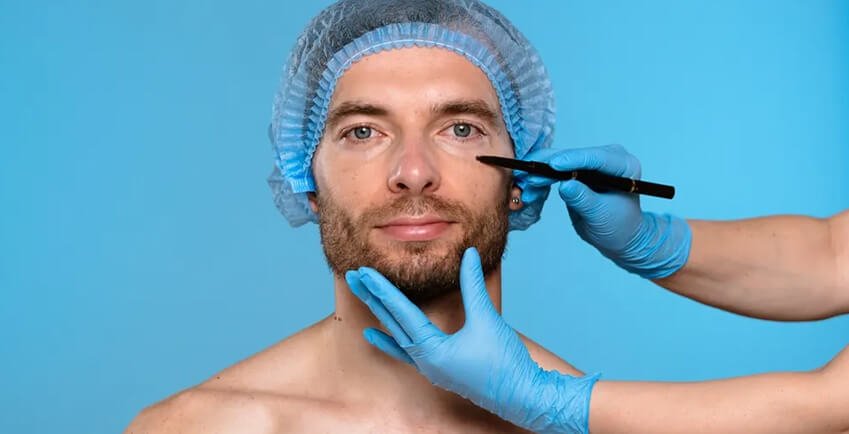
The Man In The Mirror Finally Books An Appointment
Why are more men choosing Plastic surgery?
Over dinner, we were having our usual conversation about the day’s patients when I
told my father about a young man whose wedding was only days away. He had gone to
a “wellness” salon for a pre-wedding glow a week back. What he received instead was a
skin reaction. He arrived in our OPD, asking frantically: “Sir, can these marks
be hidden before the photos?”
My father is 68 and has headed the OBGY department for more than forty years. He has
seen everything the human body can do, and very little impresses him. My father
listened, chewed thoughtfully and gave his verdict: “For my wedding,” he said, “I
used Lifebuoy soap and got a haircut.” No consultation, no serum, no
“groom package.”
My brother and I exchanged a look; neither of us was going to admit the facials we had
quietly booked before our own weddings. In one generation, #MensGrooming has gone
from Lifebuoy to laser. Mard ko dard nahi hota, we were told. Apparently, mard ko pores
bhi nahi hote, until now. This gap across one dinner table is the whole story of
#MensAesthetics.
Surgeons trust numbers. So let’s talk numbers.
According to the International Society of Aesthetic Plastic Surgery (ISAPS), men
accounted for about 14.5% of the world’s aesthetic procedures in 2023. Procedures in
men have been growing faster than in women, driven by an 18% jump in face-and-head
surgery among men. Botulinum toxin topped the non-surgical list for both sexes.
‘Brotox’ (yes, you read that right) is no longer a joke; it is a line item.
ISAPS ranks India seventh in the world, with about 12.9 lakh aesthetic procedures in
2024, roughly 25% more than the year before. Gynecomastia surgery alone crossed
47,000 cases. AIIMS New Delhi has spoken of a 250-fold rise in men seeking plastic
surgery over 25 years. Even petrol prices have shown more restraint.
#MensPlasticSurgery has quietly moved from invisibility to the gossip page to the open
OPD register.
So what changed? Five suspected forces, from childhood to the boardroom
- It starts at ten. Recently my cousin’s ten-year-old son asked me, seriously,
whether plastic surgery could give him a six-pack “with the V.” The source, he
explained, was cartoons. The anime heroes he binges have shoulders like
wardrobes and waists like test tubes, and even Chhota Bheem, powered by
laddoos, is built like a gym trainer. Nothing new: in 1999, Harvard psychiatrist
Harrison Pope scaled GI Joe up to human size. The 1960s figure had ordinary 12-
inch biceps; the 1997 version had 26-inch biceps, nearly the size of a small
man’s waist. Whatever happened to poor Suppandi, proudly useless; Chacha Chaudhary, whose brain ran faster than a computer; or Archie, who never did a
single crunch? Our childhood heroes won with wit. Today’s win with obliques. - The grooming gateway. India’s men’s grooming market is now estimated at
around ₹18,000 crore, with smaller towns leading the growth. The beard oil was
the gateway drug. Then came the serum, then the sunscreen. Once a man has a
seven-step routine and is still unhappy, he eventually finds his way to us.
#MensBeauty is no longer an oxymoron; it is a supermarket aisle – middle row. - The marriage and job market. The Indian biodata always demanded “fair, tall,
handsome.” It now quietly adds “with hair.” One industry study suggests half of
Indian men with hair loss are 25 or younger — exactly the age of first interviews
and first family “meetings.” At the other end, British surgeons reported a 26%
rise in male face and neck lifts in 2024; nobody wants to be called “uncle” in the
boardroom. - Heroes who stopped pretending. Hollywood has entered its confession era —
John Cena now talks openly about his two hair transplants. Bollywood, of
course, has officially admitted to nothing except good genes, coconut water and
“lots of discipline.” But ever since the hero took his shirt off, the male body
became a project — and a hero who lifts a jeep with one hand is expected to
have a jawline that can do the same. Every Friday release quietly raises the bar
for our Monday OPD. - Gen Z, looksmaxxing and the weight-loss jab. Online, young men practise
“mewing” for a sharper jaw and, in darker corners, inject black-market fillers into
their own faces; US surgeons now report young men arriving to fix DIY disasters.
Meanwhile, GLP-1 drugs deliver rapid weight loss — and the hollowed “Ozempic
face.” Facial fat grafting rose 50% in the US in 2024. Men lose the belly, gain a
gaunt face, and come to us for #BodyContouring at one end and volume at the
other.
What men actually ask for
#FacialAesthetics: eyelid surgery to look less tired, rhinoplasty, chin and jaw definition,
and toxin for the “angry 11.”
#HairTransplant: India performs an estimated 3.5 lakh a year; FUE centres (including
roadside hair studios) have made it feel like a weekend activity.
#BodyContouring: gynecomastia correction (the gym builds a chest but cannot delete
glandular tissue), flank and abdominal liposuction (the difficult fat to melt), and skin
excision after weight loss.
The male patient comes with his own rulebook, and its deepest rule is sexual
dimorphism. Women’s aesthetic surgery is built on curves; men’s is built on angles, as
American surgeons Daniel Beck and Josef Hadeed put it. Soften a man in the name of
youth and he does not look younger; he looks like someone else. The aim is never to
make him prettier, only more himself: rested, sharper and unmistakably male.
The uncomfortable truth
Here is the part that is not funny. Between late 2024 and early 2025, two young
engineers in Kanpur died after hair transplants allegedly performed by a dentist,
reportedly for around ₹40,000 — a fraction of the usual cost. Earlier, a 30-year-old Delhi
TV executive who simply wanted to look good enough to get married died of sepsis after
a transplant. A hair transplant is surgery: anaesthesia, thousands of incisions, real risk.
It is not a facial with extra steps. Our groom from the dinner table was lucky: his salon
cost him only a few marks and some sleep. The government now plans to treat it strictly
as surgery, done by qualified doctors in licensed facilities. About time!
The same honesty is owed to the young man who has spent eight months on a
looksmaxxing forum. Sometimes the problem is not his nose; it is the mirror he cannot
stop checking. A responsible aesthetic surgeon screens for body dysmorphia — and
sometimes says the hardest word in private practice: NO.
The bottom line
So why are more men choosing plastic surgery? Not because men suddenly became
vain. Men were always vain — watch any uncle adjusting his comb-over in a car’s side
mirror. What changed is the confession. Men can now admit they care how they look,
and modern aesthetic surgery can deliver results that are safe, subtle and predictable
— in the right hands.
My father’s generation had Lifebuoy; mine has lasers and scalpels. The man in the
mirror has finally booked an appointment. Our job is not to judge him, but to make sure
he walks out safe, better rested, more confident and still looking like himself
Author: Dr Al Iqyan Fidvi
Associate Professor,
Burns and Plastic Surgery, AIIMS, Nagpur
Email – aliqyan@aiimsnagpur.edu.in
Phone – 9623224466
Disclaimer: The opinions here are personal views of the authors. IAAPS is not responsible. All members may not have the same scientific view point